How CFDL works
CFDL (Cash Flow Domain Language) is a small, declarative language for modeling cash flows. You declare what the deal is — entities, contracts, streams, assumptions, time — and the engine derives the period-by-period cash flows and metrics. There is no imperative code path to debug: the same model always produces the same results, byte for byte.
The pipeline
Every surface (CLI, Python, playground, API server) runs the same pipeline:
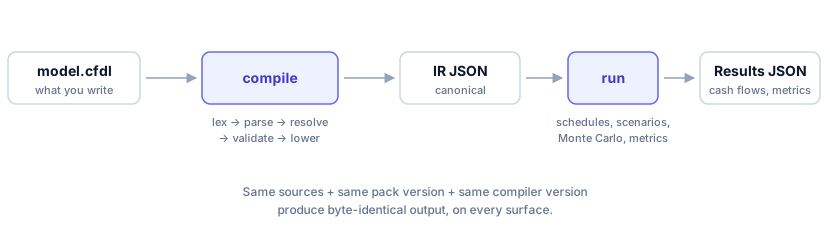
- Compile — your
.cfdlsources are lexed and parsed with full source spans, imports and symbols are resolved, the model is validated (structure, types, schedules, pack terms), and the result is lowered into a canonical IR (intermediate representation) JSON document. Same sources + same pack version + same compiler version ⇒ identical IR. - Run — the engine evaluates every stream over the model's time grid, applies scenarios and Monte Carlo trials from the run configuration, and emits a Results JSON document: per-stream cash flows, core metrics (NPV/IRR/MOIC/payback/WAL), pack domain metrics, and Monte Carlo summaries with percentiles.
Both documents have published JSON Schemas — see the IR schema and Results schema.
What a model contains
- Time — one calendar declaration (
time calendar monthly from 2026-01 for 72) defines the period grid everything else lands on. - Entities — the things a model is about. An
assetproduces or consumes cash (entity asset tower : CRE.Asset.RealProperty); apartycontracts, owns or lends (entity party acme : CRE.Party.Tenant). A type is checked against the active pack's vocabulary. See the object model. - Lifecycles — a declared finite state machine: enumerated states and
guarded edges, evaluated each period the entity is in the edge's from-state.
A unit goes delinquent because last period's rent came in short, and cures
when it resumes — the topology walked as often as the deal's history walks
it. A model declares one with a
lifecycleblock, or a pack declares it on the type. - Streams — dated cash flow series with a schedule and an amount expression. The lowest-level building block.
- Contracts — pack-templated bundles of streams declared with business
terms (
contract cre.lease { terms { rent = 25000 } }). The compiler expands them into streams using the pack's rules. - Events and options — an event is a condition and a one-time change
(
event expiry when time.t >= 24 { set entity asset.suite.status = "vacant" }); an option is a contract with an exercise condition and a payoff. A regime that returns is a lifecycle edge, not an event. Transitions from all three are recorded in results as a transition log. - Accounts — declared cash locations whose balances accumulate across
periods: a reserve funded to a target, proceeds waiting for a quarterly
distribution date. A waterfall draws one with
from <account>, a step pays into one, and logic reads its settled balance asprev.<account>. - Assumptions — named inputs, fixed (
assume rate = 0.10) or stochastic (assume growth ~ Normal(mean=0.02, stdev=0.01)), referenced from expressions asinputs.<name>. - Expressions — bare, Excel-familiar formulas
(
base_rent * pow(1 + escalation, years)) with decimal money math and a financial function library (pmt,year_frac,eomonth,macrs_rate, …). See the expression environment.
Packs
Domain packs (energy, CRE, credit, opco) supply contract templates, term validations, and industry metrics, so models read like term sheets instead of formula collections. Every pack is gated by a benchmark parity suite against independent reference models.
Determinism and reproducibility
- Compilation is deterministic: IR arrays are canonically ordered and IDs derive from stable keys.
- Monte Carlo is deterministic: every run declares an explicit seed, and each assumption gets its own seeded draw stream — adding an assumption never reshuffles another's draws. Runs are byte-reproducible across machines and across surfaces (the CLI, Python SDK, browser playground, and API server embed the same compiler and engine).
- Results carry the model hash and engine version, so any output can be traced back to exactly what produced it.
Where each surface fits
| Surface | Use it when… | Setup |
|---|---|---|
| Playground | trying the language, sharing a snippet | none — runs in your browser |
| CLI | files-and-git workflows, CI, golden testing | Install the CLI |
| Python SDK | notebooks, pandas analysis, charts | Install for Python |
| API server | integrating CFDL into another product | Run the server |
| VS Code | authoring models with diagnostics + hover | VS Code and LSP |
Next: Getting started walks you through your first model.