CRE office acquisition (institutional lease-by-lease DCF)
Outputs below are real: the notebook runs against the
crepack's benchmark model, which CFDL validates against an independent reference. To run it yourself, see the Python SDK guide.
A two-minute agent-driven walkthrough: an AI agent executes this notebook cell by cell, every output computing live in the take. Captions carry the narration.

A two-tenant office acquisition modeled lease-by-lease: free rent, anniversary escalations, expense recoveries over stops, TI/LC, probability-weighted rollover, and an exit on forward NOI.
This notebook uses one of the benchmark models, which CFDL validates against an independent reference to the penny.
# On Colab, install the SDK and fetch the models this notebook reads.
# Inside a checkout both are already present and this cell does nothing.
import subprocess, sys
from pathlib import Path

REPO = "https://github.com/cfdl-dev/cfdl"


def repo_root() -> Path:
    """The checkout holding benchmarks/ and packs/, cloning it if need be.

    Searching a bounded set of ancestors means a plain `python` run outside a
    checkout fails with an explanation rather than walking to the filesystem
    root. On a hosted runtime there is no checkout to find, so fetch one.
    """
    here = Path.cwd().resolve()
    for candidate in (here, *here.parents):
        if (candidate / "Cargo.toml").exists() and (candidate / "packs").is_dir():
            return candidate

    if "google.colab" not in sys.modules:
        raise RuntimeError(
            f"No CFDL checkout found above {here}. This notebook reads a model "
            f"from benchmarks/ and pack definitions from packs/, so run it "
            f"inside a clone of {REPO}."
        )

    subprocess.run([sys.executable, "-m", "pip", "install", "-q", "cfdl-sdk[viz]"], check=True)

    # Packs and benchmark models track the engine, so take the checkout at the
    # tag matching the wheel pip just resolved. `main` runs ahead of the last
    # release and its packs may use metric ops the released engine rejects.
    import importlib
    from importlib.metadata import PackageNotFoundError, version

    importlib.invalidate_caches()
    try:
        tag = f"v{version('cfdl-sdk')}"
    except PackageNotFoundError:
        tag = None

    clone = ["git", "clone", "--depth", "1", "-q", REPO]
    target = Path("/content/cfdl")
    if not target.exists():
        pinned = tag is not None and not subprocess.run(
            clone + ["--branch", tag, str(target)]
        ).returncode
        if not pinned:
            # A dev or pre-release wheel has no matching tag; main is the best
            # available, and the notebook may fail if the two have diverged.
            print(f"warning: no {tag} tag for this SDK build; falling back to main.")
            subprocess.run(clone + [str(target)], check=True)
    return target


ROOT = repo_root()
PACKS = ROOT / "packs"

import cfdl_sdkCompile
Compile the model directory to IR.
model_dir = ROOT / "benchmarks/cre/office_two_tenant"
model = cfdl_sdk.compile(model_dir, packs_dir=PACKS)
print("streams:", len(model.ir["streams"]))streams: 17
Run
Run with the benchmark's configuration and apply the cre pack's domain metrics.
results = model.run(
    config=str(model_dir / "run.json"),
    pack="cre",
)
print("status:", results.status, "| warnings:", len(results.warnings))status: ok | warnings: 0
Cash flows
The engine returns per-period signed cash flows; cashflows() gives a wide DataFrame indexed by period.
cf = results.cashflows()
print('shape:', cf.shape)
cf.head()shape: (120, 27)
         account.asset.tower.balance  domain.cre.debt_service  domain.cre.dscr  domain.cre.egi  \
period
2026-01                 5.990655e+06             36845.249537        -0.719224         -1500.0
2026-02                 5.981267e+06             36845.249537        -0.719224         -1500.0
2026-03                 5.971836e+06             36845.249537        -0.719224         -1500.0
2026-04                 5.962361e+06             36845.249537         0.366397         38500.0
2026-05                 5.952843e+06             36845.249537         0.366397         38500.0

         domain.cre.leasing_costs  domain.cre.noi  domain.cre.opex_total  domain.cre.pgr  \
period
2026-01                  200000.0        -26500.0               -25000.0         40000.0
2026-02                       0.0        -26500.0               -25000.0         40000.0
2026-03                       0.0        -26500.0               -25000.0         40000.0
2026-04                       0.0         13500.0               -25000.0         40000.0
2026-05                       0.0         13500.0               -25000.0         40000.0

         entity.asset.tower.net_cash_flow  model.net_cash_flow  ...  \
period                                                          ...
2026-01                    -263345.249537       -263345.249537  ...
2026-02                     -63345.249537        -63345.249537  ...
2026-03                     -63345.249537        -63345.249537  ...
2026-04                     -23345.249537        -23345.249537  ...
2026-05                     -23345.249537        -23345.249537  ...

         stream.cre.rollover.ti_lc.tenant_a  stream.cre.unit.abatement.tenant_a  \
period
2026-01                                 0.0                            -40000.0
2026-02                                 0.0                            -40000.0
2026-03                                 0.0                            -40000.0
2026-04                                 0.0                                 0.0
2026-05                                 0.0                                 0.0

         stream.cre.unit.abatement.tenant_b  stream.cre.unit.base_rent.tenant_a  \
period
2026-01                                 0.0                             40000.0
2026-02                                 0.0                             40000.0
2026-03                                 0.0                             40000.0
2026-04                                 0.0                             40000.0
2026-05                                 0.0                             40000.0

         stream.cre.unit.base_rent.tenant_b  stream.cre.unit.recoveries.tenant_a  \
period
2026-01                                 0.0                                  0.0
2026-02                                 0.0                                  0.0
2026-03                                 0.0                                  0.0
2026-04                                 0.0                                  0.0
2026-05                                 0.0                                  0.0

         stream.cre.unit.recoveries.tenant_b  stream.cre.unit.ti_lc.tenant_a  \
period
2026-01                                  0.0                       -200000.0
2026-02                                  0.0                             0.0
2026-03                                  0.0                             0.0
2026-04                                  0.0                             0.0
2026-05                                  0.0                             0.0

         stream.cre.unit.ti_lc.tenant_b  stream.cre.vacancy.loss
period
2026-01                             0.0                  -1500.0
2026-02                             0.0                  -1500.0
2026-03                             0.0                  -1500.0
2026-04                             0.0                  -1500.0
2026-05                             0.0                  -1500.0

[5 rows x 27 columns]
# Requires the [viz] extra (pip install cfdl-sdk[viz]).
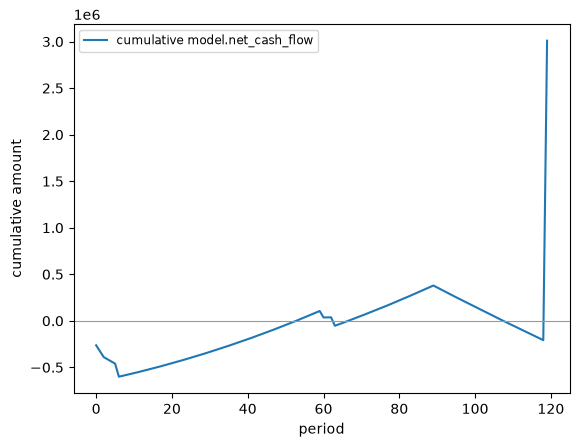
results.plot.cumulative()<Axes: xlabel='period', ylabel='cumulative amount'>
Metrics
Core metrics (NPV/IRR/MOIC/...) plus the pack's domain metrics, with their source labeled.
results.metrics_frame() metric value currency source
0 domain.cre.debt_service 4.421430e+06 USD domain:cre
1 domain.cre.dscr 1.067287e+00 domain:cre
2 domain.cre.leasing_costs 5.250000e+05 USD domain:cre
3 domain.cre.noi 4.718934e+06 USD domain:cre
4 entity.asset.tower.total 3.009647e+06 USD core
5 model.irr 2.907830e-01 core
6 model.moic 3.234175e+00 core
7 model.npv 1.424274e+06 USD core
8 model.payback_periods 5.300000e+01 core
9 model.payback_years 4.500000e+00 core
10 model.total 3.009647e+06 USD core
11 model.wal_years 8.508512e+00 core
12 run.annual_discount_rate 7.250000e-02 core
13 run.periods_per_year 1.200000e+01 core
14 stream.cre.debt.interest.total -2.930792e+06 USD core
15 stream.cre.debt.principal.total -1.490638e+06 USD core
16 stream.cre.debt.proceeds.total 0.000000e+00 USD core
17 stream.cre.exit.proceeds.total 3.303207e+06 USD core
18 stream.cre.exit.selling_costs.total -6.606414e+04 USD core
19 stream.cre.opex.line.total -3.361015e+06 USD core
20 stream.cre.rollover.rent.tenant_a.total 2.782460e+06 USD core
21 stream.cre.rollover.ti_lc.tenant_a.t... -1.750000e+05 USD core
22 stream.cre.unit.abatement.tenant_a.t... -1.200000e+05 USD core
23 stream.cre.unit.abatement.tenant_b.t... 0.000000e+00 USD core
24 stream.cre.unit.base_rent.tenant_a.t... 2.548385e+06 USD core
25 stream.cre.unit.base_rent.tenant_b.t... 2.717075e+06 USD core
26 stream.cre.unit.recoveries.tenant_a.... 3.075942e+04 USD core
27 stream.cre.unit.recoveries.tenant_b.... 3.012687e+05 USD core
28 stream.cre.unit.ti_lc.tenant_a.total -2.000000e+05 USD core
29 stream.cre.unit.ti_lc.tenant_b.total -1.500000e+05 USD core
30 stream.cre.vacancy.loss.total -1.800000e+05 USD core
What-if
Inspect the derived forward-NOI exit value and the DSCR domain metric.
mf = results.metrics_frame()
mf[mf["metric"].str.contains("dscr|noi|exit", case=False)] metric value currency source
1 domain.cre.dscr 1.067287e+00 domain:cre
3 domain.cre.noi 4.718934e+06 USD domain:cre
17 stream.cre.exit.proceeds.total 3.303207e+06 USD core
18 stream.cre.exit.selling_costs.total -6.606414e+04 USD core
Extended analysis — the DataFrame is the API
Everything below is ordinary pandas over cashflows(). The engine guarantees the
numbers (this case is asserted against an independent reference in CI); the
analysis on top is yours.
# Annual rollup with a computed coverage column.
annual = cf[["domain.cre.egi", "domain.cre.noi", "domain.cre.debt_service"]].groupby(cf.index.year).sum()
annual["dscr"] = annual["domain.cre.noi"] / annual["domain.cre.debt_service"]
annual.round(2) domain.cre.egi domain.cre.noi domain.cre.debt_service dscr
period
2026 540000.00 240000.00 442142.99 0.54
2027 881025.00 573525.00 442142.99 1.30
2028 910322.62 595135.12 442142.99 1.35
2029 940426.85 617359.66 442142.99 1.40
2030 971360.07 640216.20 442142.99 1.45
2031 920924.75 581502.28 442142.99 1.32
2032 991457.87 643549.84 442142.99 1.46
2033 780329.82 423724.09 442142.99 0.96
2034 563330.76 197809.89 442142.99 0.45
2035 580770.69 206111.80 442142.99 0.47
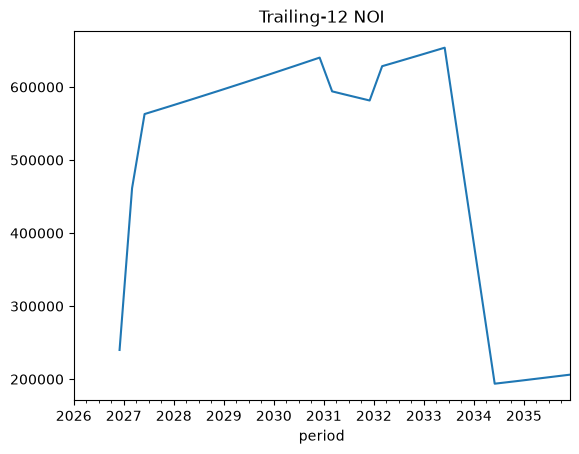
Year one is lease-up — a 0.5x coverage year a lifetime DSCR of 1.07 would have hidden entirely. Per-period series are what make covenant work possible.
# Covenant screen and trailing-12 NOI.
tight = cf[cf["domain.cre.dscr"] < 1.0]
print(f"months below 1.00x DSCR: {len(tight)} of {len(cf)} (last: {tight.index.max()})")
cf["domain.cre.noi"].rolling(12).sum().plot(title="Trailing-12 NOI")months below 1.00x DSCR: 36 of 120 (last: 2035-12)
<Axes: title={'center': 'Trailing-12 NOI'}, xlabel='period'>
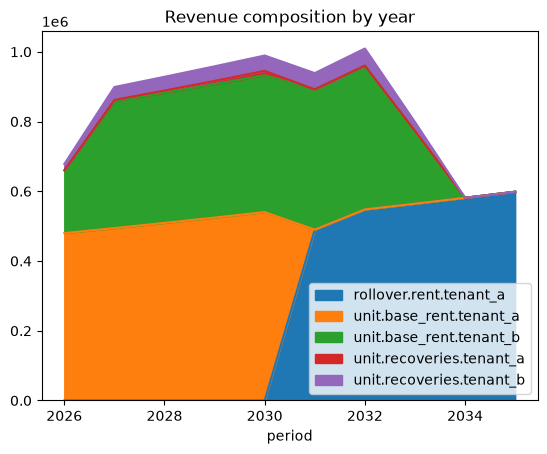
# Tenant-level revenue composition: the lease-by-lease grain survives into results.
rev_cols = [c for c in cf.columns if ".base_rent." in c or ".recoveries." in c or ".rollover.rent." in c]
rev = cf[rev_cols].groupby(cf.index.year).sum()
rev.rename(columns=lambda c: c.replace("stream.cre.", "")).plot.area(title="Revenue composition by year")<Axes: title={'center': 'Revenue composition by year'}, xlabel='period'>
# Value sensitivity: re-run the deal across a discount grid — four engine runs.
import pandas as pd
npv = pd.Series({
    rate: model.run(config={"deterministic": {"annual_discount_rate": rate}}, pack="cre").metrics()["model.npv"]
    for rate in (0.06, 0.08, 0.10, 0.12)
})
npv.round(0)0.06 1622142.0
0.08 1316581.0
0.10 1064405.0
0.12 855277.0
dtype: float64